
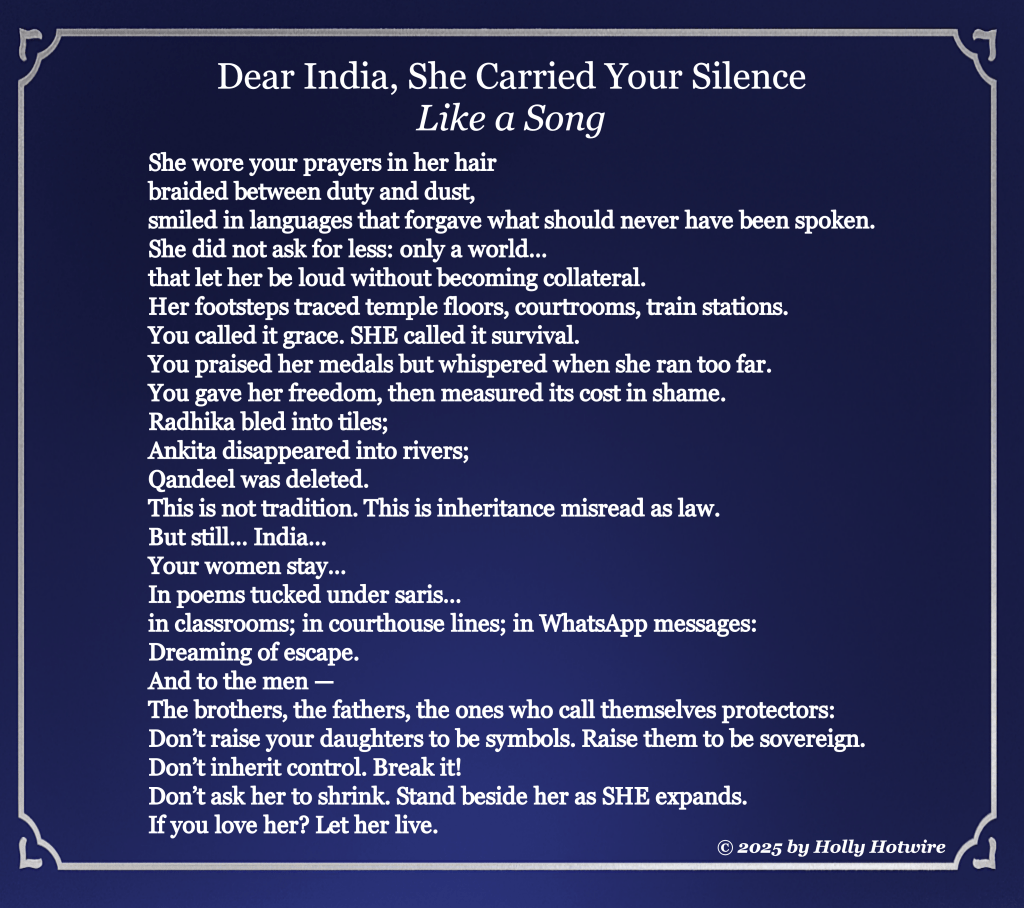
Success Made Radhika Yadav Free. Obedience Would’ve Kept Her Alive.
Radhika Yadav rewrote what self-reliance looked like in a house built on old rules. As her ranking climbed and her coaching roster grew, the silence at home grew louder. The trigger wasn’t her success; it was her refusal to apologize for it.
By the time her father stepped into the kitchen with a pistol, their dynamic had already collapsed under the weight of unspoken resentment and public shame. This was a reckoning inside four walls that couldn’t contain what she’d become.
The aftermath wasn’t quiet. News anchors flashed her face across prime time, narrating a tragedy too brutal to soften. But behind the headlines, the story metastasized into something murkier: family honor, gendered resentment, and the cost of female ambition.
The trigger wasn’t her success;
it was her refusal to apologize for it.
Her name lit up Reddit threads dissecting her choices, and Twitter timelines debated whether ambition had a cost. The digital reaction wasn’t grief; it was guilt refracted through screens.
Much like Ankita Bhandari before her, the violence was framed as a one-off act. But every detail exposed a pattern: of fathers shattered by daughters who refused shame as inheritance.
The police called it a “domestic dispute.” The country called it a heartbreak. But those closest knew better: It was retaliation.
When Grief Becomes a Mirror
The headlines faded, but the discomfort lingered. Radhika’s story did not dissolve; it haunted and it echoed. In homes where daughters are praised but policed, her death became a cautionary tale, whispered through the hush of closed-door conversations.
Her WhatsApp messages to her coach revealed a longing for escape, not rebellion: “Wanna enjoy life, idhar kaafi restrictions hai,” she wrote She was a young woman longing to study abroad, to live independently for a while. Not forever. Just for herself. NDTV later reported those aspirations in coverage of her case.
But independence, in her father’s eyes, wasn’t growth. It was defiance. And in communities where obedience is rewarded and silence is expected, longing becomes a threat. Her dreams didn’t collapse; they were confronted with violence.
The backlash was cultural. Much like the case of Ankita Bhandari, whose murder was framed as a one-off act despite systemic patterns, Radhika’s tragedy exposed how female autonomy still threatens fragile masculinity.
Her father’s confession deepened the rupture. Reportedly influenced by acquaintances who mocked his dependence on her earnings, he told police his pride had been “hurt beyond repair,” as reported by Hindustan Times.
The Myth of the Good Father
In the days after Radhika’s funeral, the narrative began to shift. Neighbors described her father as “quiet,” “respectable,” even “loving.” News segments replayed old footage of him cheering from the sidelines at her matches, as if proximity to pride could absolve violence. But the truth was simpler and more brutal: he didn’t snap. He simmered.
According to police reports, Deepak Yadav had been stewing over perceived humiliation for weeks, triggered by taunts from relatives who mocked his dependence on her income (Economic Times). His confession was a blueprint of entitlement.
Much like the case of Ankita Bhandari, whose murder was initially framed as a tragic anomaly, Radhika’s death revealed a deeper rot: the myth of the good father who simply “lost control.” But control was never the issue; it was ownership. In homes where daughters are raised to shine but not outshine, love often comes with conditions. And when those conditions are defied, the fallout isn’t just emotional—it’s fatal. Radhika didn’t die because she failed to meet expectations. She died because she exceeded them.
💔 Cultural Beliefs That Killed 💔
| Victim | Relation to Murderer | Year | Cultural Belief That Led to Death | Source |
|---|---|---|---|---|
| Radhika Yadav | Father | 2025 | Female success without apology is defiance; daughters must not outshine male authority | IndiaTV |
| Ankita Bhandari | Employer (political ties) | 2022 | Women’s autonomy threatens male reputation; silence is preferred over scandal | Wikipedia |
| Shafilea Ahmed | Parents | 2003 | Westernization equals dishonor; daughters must obey cultural norms regardless of geography | The Desi Condition |
| Qandeel Baloch | Brother | 2016 | Public female expression is shameful; family honor rests on women’s modesty | Global Citizen |
| Davalbi Tambad | Father & brothers | 2021 | Interfaith love is betrayal; daughters must marry within religion to preserve family purity | The Desi Condition |
| Celine Dookhran | Uncle | 2017 | Romantic autonomy is forbidden; women must conform to arranged marriage expectations | Independent UK |
When Culture Wears a Mask of Care
Radhika’s death didn’t occur in isolation. It played out a script familiar to women across communities where silence is expected and obedience is romanticized.
Her father’s simmering resentment wasn’t just personal; it was fueled by cultural messaging that sees daughters not as individuals, but as honor-bearing assets.
Like Qandeel Baloch, whose digital self-expression was deemed a threat to family reputation, Radhika also stepped into a spotlight she wasn’t meant to own. Not with rebellion. But with dreams. With choices. And sometimes, that’s all it takes to trigger rupture.
The crime wasn’t born in a moment. It grew quietly in rooms where ambition is flattered until it threatens inherited control.
When Boundaries Become Betrayal
Even for families who’ve left their homeland, the belief persists: that conformity is care and tradition is protection. Displacement may shift geography, but inherited expectations remain intact — often disguised as love.
Shafilea Ahmed’s parents masked coercion with concern. Their punishment for rejecting a forced marriage wasn’t just personal; it was cultural. Her story echoed across generations, unsettling those taught that silence is survival.
Celine Dookhran, whose uncle murdered her for defying marital expectations. These weren’t spontaneous eruptions of violence. They were culminations of belief systems that treat female autonomy as erosion, not evolution. And until that lens is broken, every success story risks ending as a cautionary tale.
Where Permission Ends, Possession Begins
A girl’s ambition doesn’t rupture tradition. It exposes who tradition protects. In too many households, it quietly unsettles what tradition was built to preserve. In homes where daughters are adored but monitored, independence is welcomed only when it remains admired from a distance, silenced when it starts to speak for itself.
A girl’s ambition doesn’t rupture tradition.
It exposes who tradition protects.
We cannot archive these stories as anomalies. To do so erases the map of how it happens. Not of the girls, but of the systems that silence them — threaded through caste, class, diaspora, and generation. Until autonomy is seen not as betrayal, but as birthright, every choice she makes will be measured against the comfort it disrupts. And every father who feels “hurt beyond repair” will be protected by the culture that taught him to feel that way.
~ * ~ Holly out for now. ~ * ~
 Hot & Not in Hollywood
Leave a comment