

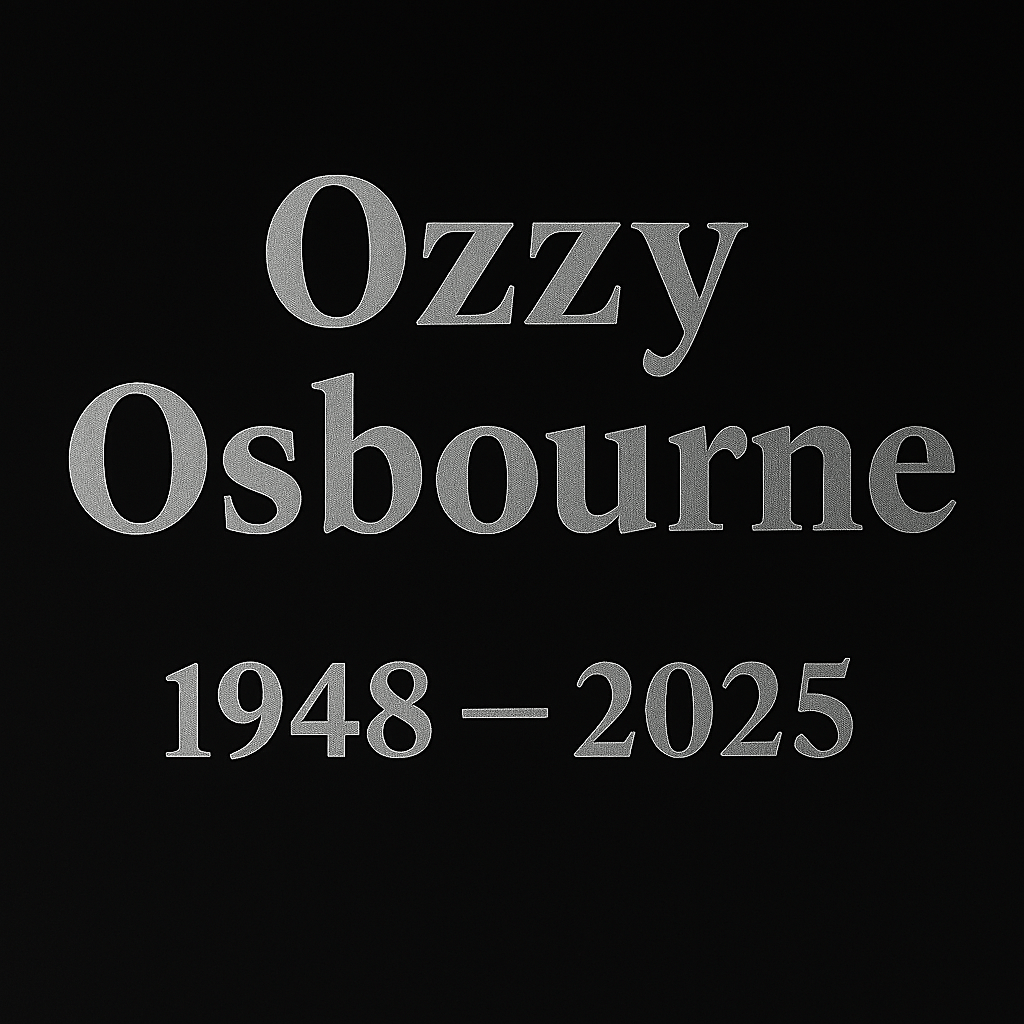
Heavy metal lost its most iconic survivor with the death of Ozzy Osbourne at age 76. As the founding voice of Black Sabbath and the unexpected patriarch of reality TV, Ozzy left behind not just a discography but a mythology that was gritty, absurd, tender, and loud.
His legacy includes Grammy-winning metal, viral mischief, and a kind of emotional chaos that felt honest. For fans who grew up under his howl, and for those who discovered him through The Osbournes, Ozzy wasn’t just a rock star. He proved that broken voices can still lead revolutions.
The Final Curtain at Villa Park
On July 5, 2025, Ozzy Osbourne returned to Birmingham for what became his final performance: the “Back to the Beginning” concert at Villa Park. The show was more than a farewell; it was communion.
Thousands gathered as Ozzy reunited with Black Sabbath’s original lineup: Tony Iommi, Geezer Butler, and Bill Ward. From “Crazy Train” to “Paranoid,” every track felt like a thunderclap from 1970. Fans traveled across continents to witness what Rolling Stone called a “lauded, sold-out concert” that paid reverent tribute to metal’s royal lineage.
From Birmingham to Mythology
Born John Michael Osbourne, Ozzy grew up in working-class Birmingham. As he told Esquire, intimidation and poverty were constants, but humor became his shield. “I always felt crappy and intimidated by everyone… So my whole thing was to act crazy and make people laugh so they wouldn’t jump on me.”
This mischief mutated into musical force when he discovered the Beatles at 14, an epiphany he once described as “divine.” His early struggles, from school drop-out to petty crime, laid the foundation for a voice that could channel both anguish and defiance.
Black Sabbath: Soundtrack of Rebellion
Black Sabbath wasn’t just a band; it was a sonic revolution. When Ozzy joined forces with Iommi, Butler, and Ward in 1969, the result was a fusion of gothic doom and blue-collar rage.
Tracks like “Iron Man” and “War Pigs” weren’t mere songs; they were seismic warnings. Ozzy’s voice summoned dread like a horror protagonist dragged through hell.
Even Metallica’s Lars Ulrich admitted the heavy-metal genre “might as well be subtitled ‘Music derivative of Black Sabbath’,” according to Rolling Stone.
Solo Stardom and the Ozzy Myth
After being dismissed from Sabbath in 1979, for being more stoned than the rest, Ozzy launched a solo career that embraced spectacle and pain. Backed by Randy Rhoads and later Zakk Wylde, albums like Blizzard of Ozz and Diary of a Madman sounded like exorcisms with distortion pedals. Tracks such as “Mr. Crowley” and “Suicide Solution” mixed neo-classical shredding with psychological free fall.
His behavior after biting off a bat’s head and urinating on the Alamo, was chaotic, but the music never lost its emotional core.
As Ozzy once put it, “You couldn’t write my story; you couldn’t invent me.” His legend was sealed, but a new kind of chaos was waiting in America’s living rooms.
Reality TV, Ozzfest, and Mainstream Love
The 1990s turned Ozzy into metal’s patriarch. Ozzfest brought extreme music to the masses, giving heavy acts like Slayer and Pantera a permanent home. But it was The Osbournes that flipped his image. The show revealed a befuddled dad with a sailor’s vocabulary, struggling with his remote control like every other father in America. It even won an Emmy. Ozzy became the charming chaos in a world craving authenticity. Rolling Stone’s obituary notes how this pivot transformed him from “rock savage” into America’s sweetheart.
“Being a rock star is easy. Being a survivor — that’s the hard part.” — Ozzy Osbourne
Legacy Beyond the Grave
Ozzy Osbourne died “surrounded by love,” his family confirmed, after battling Parkinson’s and other health issues. His legacy spans four Grammy Awards and chart-topping albums with both Sabbath and as a solo artist.
Brian May once called him “a willowy singer wailing in a way that made the kids’ parents despair,” a perfect summary of how rebellion and vulnerability shaped his art. More than a performer, Ozzy was proof that broken voices can still roar, and even the darkest lyrics can be cathartic.
~ * ~ Holly out for now. ~ * ~
 Hot & Not in Hollywood
Leave a comment